





Loose Dental Implant Crown: Screw Loosening vs Cement Failure
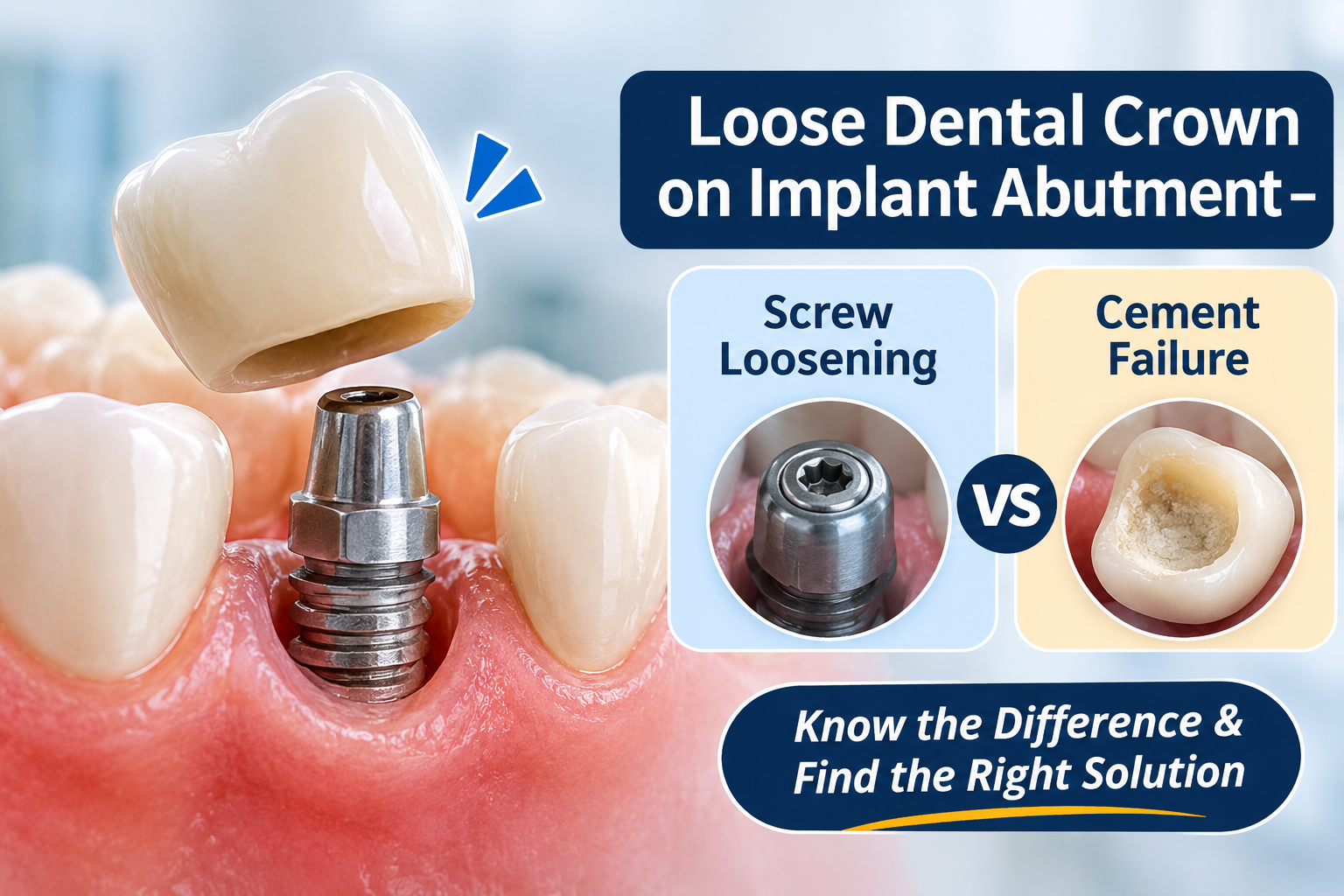


Loose Dental Crown on Implant Abutment: Screw Loosening vs Cement Failure
Dental implants are designed to provide a stable replacement for missing teeth. However, even after successful implant treatment, the crown attached to the implant may sometimes become loose. Patients may notice movement while chewing, a clicking sensation or a change in the way the crown feels when biting.
A loose implant crown does not necessarily mean that the implant itself has failed. The problem may involve the abutment screw, the cement holding the crown or another component of the restoration.
Two common causes are implant abutment screw loosening and cement failure. Understanding the difference helps explain why a dental examination is important before attempting any repair.
How Is a Dental Implant Crown Attached?
A dental implant restoration generally consists of three main components:
- Implant fixture: A titanium or other biocompatible post placed in the jawbone to replace the tooth root.
- Abutment: The connector attached to the implant that supports the crown.
- Dental crown: The visible artificial tooth that restores appearance and chewing function.
Depending on the restoration design, the crown may be attached directly with a screw or cemented onto an abutment.
When any connection becomes loose, the crown may move. Identifying which component has lost stability is the first step in choosing the appropriate treatment.
1. What Is Implant Abutment Screw Loosening?
In an implant-supported restoration, the abutment is secured to the implant fixture using a specialised screw. This screw must maintain the correct tightening force, known as preload, to keep the connection stable.
Over time, mechanical forces from chewing can contribute to screw loosening, particularly when the restoration experiences excessive or uneven loading.
Common Causes of Abutment Screw Loosening
- Excessive biting forces or an uneven bite.
- Teeth grinding or clenching (bruxism).
- Incorrect tightening torque during placement.
- Poor fit between implant components.
- Repeated mechanical stress during chewing.
- Restoration design factors, including cantilevers.
Signs of a Loose Abutment Screw
Patients may experience:
- Movement of the crown while chewing.
- Clicking or slight rocking sensations.
- A change in the bite.
- Discomfort when biting.
- A visible gap around the crown or abutment in some cases.
In certain situations, the crown and abutment may move together because the screw connecting the abutment to the implant has loosened.
2. What Is Cement Failure in an Implant Crown?
Some implant crowns are cement-retained. In this design, the abutment is secured to the implant with a screw, while the crown is attached to the abutment using dental cement.
Cement failure occurs when the bond between the crown and abutment weakens or breaks. As a result, the crown may become loose or detach even though the underlying abutment screw remains secure.
Common Causes of Cement Failure
- Loss of cement retention over time.
- Inadequate retention or preparation of the abutment.
- Excessive biting forces.
- Poor crown fit.
- Inappropriate cement selection or cementation technique.
- Repeated mechanical stress.
Signs of Cement Failure
Patients may notice:
- The crown moving independently of the underlying abutment.
- A crown that feels loose while the implant connection remains stable.
- Food getting trapped around the restoration.
- A crown that partially lifts or comes off.
- Changes in chewing comfort.
A detached crown should be assessed promptly, even if there is no pain.
3. Screw Loosening vs Cement Failure: Key Differences
Both conditions can cause an implant crown to feel unstable, but they affect different connections within the restoration.
| Feature | Abutment Screw Loosening | Cement Failure |
|---|---|---|
| Affected connection | Abutment to implant | Crown to abutment |
| Main problem | Screw loses tightening stability | Cement bond loses retention |
| Crown movement | Crown and abutment may move together | Crown may move independently |
| Possible symptoms | Clicking, rocking or bite changes | Loose or partially detached crown |
| Treatment | Screw assessment, tightening or replacement | Crown removal, cleaning and recementation if suitable |
These are general clinical patterns, not a reliable way to diagnose the problem at home. Some restorations have designs that make the two conditions difficult to distinguish without examination.
4. How Does a Dentist Identify the Actual Problem?
A loose implant crown needs a clinical examination to identify the affected component.
1. Clinical Examination
The dentist checks the movement, stability and fit of the crown. The location and direction of movement can provide useful diagnostic information.
2. Review of Implant Restoration Design
The dentist identifies whether the crown is screw-retained or cement-retained and checks the implant and abutment system.
3. Radiographic Examination
An X-ray may help assess the implant-abutment connection, surrounding bone support and possible component problems.
4. Bite and Occlusion Assessment
The dentist checks whether the crown is receiving excessive or uneven biting pressure. Grinding and clenching habits may also be considered.
5. Component Inspection
If clinically necessary, the restoration may be removed to inspect the screw, abutment, crown and connecting surfaces.
The objective is to distinguish a simple prosthetic complication from a more serious issue involving the implant itself.
5. Treatment Options for a Loose Implant Crown
Treatment depends on the underlying cause and whether the crown, abutment and implant components are still suitable for reuse.
If the Abutment Screw Is Loose
The dentist may:
- Access and inspect the screw.
- Check the implant and abutment connection.
- Clean the connecting components.
- Replace a damaged screw if necessary.
- Tighten the screw using the manufacturer's recommended torque.
- Adjust the bite if excessive loading is contributing to the problem.
Repeated screw loosening requires further investigation rather than simply tightening the same component each time.
If the Crown Has Lost Cement Retention
The dentist may:
- Carefully remove the loose crown.
- Inspect the crown and abutment for damage.
- Remove residual cement.
- Check the fit and retention.
- Recement the crown if the components remain suitable.
If the crown is damaged or does not fit correctly, a replacement restoration may be required.
If the Implant or Other Components Are Damaged
A more detailed assessment may be needed if the implant fixture, abutment or screw is fractured or if there are signs of infection or loss of supporting bone. Treatment will depend on the specific diagnosis.
6. What Should You Do If Your Implant Crown Becomes Loose?
If you notice movement in your implant crown, avoid putting additional pressure on it.
Follow these precautions:
- Contact your implant dentist for an appointment.
- Avoid chewing hard or sticky foods on the affected side.
- Do not try to tighten the crown yourself.
- Do not use household glue or over-the-counter adhesives.
- If the crown comes off, keep it in a clean container and take it to your dentist.
- Avoid repeatedly touching or moving the restoration with your fingers or tongue.
Seek prompt dental attention if the crown is very mobile, has detached, or is causing pain or swelling. Difficulty swallowing or breathing requires emergency medical attention.
Dental Implant Crown Assessment at Uniq Dental Clinic, Coimbatore
A loose implant crown should be evaluated to determine whether the issue involves screw loosening, cement failure or another prosthetic complication. Treating the actual cause is important for restoring stability and protecting the implant components.
At Uniq Dental Clinic, Coimbatore, patients can consult the dental team for implant-related concerns, including loose crowns, implant restoration problems and replacement of missing teeth.
Whether your crown has started moving while chewing or has completely detached, a clinical examination can help identify the problem and determine suitable treatment options.
Explore dental implant treatment in Coimbatore at Uniq Dental Clinic.
Clinic Address: 43, B-10, Sathy Road, Near Hotel Annapoorna, Ganapathy, Coimbatore, Tamil Nadu 641006.
For an implant consultation, contact Uniq Dental Clinic at +91 99424 22008 or visit the official clinic website.
Frequently Asked Questions About Loose Dental Implant Crowns
A loose implant crown may result from abutment screw loosening, cement failure, a damaged component or another problem with the restoration. A dentist needs to examine it to identify the cause.
Not necessarily. The crown or abutment connection may be loose even when the implant fixture remains stable in the jawbone. However, implant stability and surrounding bone health should be checked.
In many cases, yes. If the implant fixture is stable and the crown and other components are suitable for reuse, the dentist may be able to repair the connection or recement the crown.
Avoid chewing on the affected side, especially hard, crunchy or sticky foods, until the crown has been assessed. Continued pressure may worsen the damage.
Yes. In many cement-retained implant restorations, the abutment is secured to the implant with a screw, while the crown is cemented onto the abutment. Therefore, either the cement connection or the abutment screw can become loose.
Repeated loosening may be associated with excessive bite forces, bruxism, component fit, restoration design or other mechanical factors. The dentist should investigate the cause rather than repeatedly performing the same repair.
Maintain good oral hygiene, attend regular implant reviews, follow your dentist's instructions and seek assessment if you grind or clench your teeth. Regular checks can help identify mechanical problems before they become more complicated.